WHAT IT IS
A synthetic analogue of growth hormone–releasing hormone (GHRH) that signals the pituitary gland to release growth hormone.

Connect with us


.png)

Schedule a Consultation!
There is no FDA-approved adult dose of sermorelin. Approval was withdrawn in 2009, and what is prescribed today is compounded. Here is what the label actually covered, what compounding pharmacies prepare, and what the evidence does and does not establish.
Timothy Mackey, D.O., Medical Director
Florida License OS9185 · Updated September 2026
A consultation does not guarantee a prescription. Eligible Florida patients may be seen by telemedicine when clinically appropriate.

A synthetic analogue of growth hormone–releasing hormone (GHRH) that signals the pituitary gland to release growth hormone.
FDA approval was withdrawn in June 2009 — for business reasons, not safety or effectiveness. There is no marketed FDA-approved sermorelin product in the United States today.
It is not a shortcut for anti-aging, muscle gain, or weight loss. History, symptoms, IGF-1, glucose and risk factors all matter before anything is prescribed.
Sermorelin acts through the body’s growth-hormone signaling pathway rather than supplying growth hormone directly. Its effect depends on pituitary function and can increase insulin-like growth factor-1 (IGF-1).
That mechanism is clinically relevant, but it does not prove broad claims commonly made online about fat loss, recovery, sleep, or “reversing aging.” A responsible decision begins with an individualized medical evaluation.
Read the peptide therapy cornerstone guide →There is no FDA-approved adult sermorelin dose. That is the accurate answer, and it is not the answer most pages give.
What does exist is a convention among compounding pharmacies, and those pharmacies publish it openly. Empower Pharmacy states that a common adult dosing regimen for growth hormone deficiency is 0.2 to 0.3 mg of sermorelin acetate injected subcutaneously once daily at bedtime. Olympia Pharmaceuticals and other compounders describe similar nightly subcutaneous dosing in the 200 to 300 microgram range.
Read that for what it is. It describes what compounders prepare and what prescribers commonly order. It is not an approved dosing standard, it was not established in registration trials for adult use, and it varies between pharmacies.
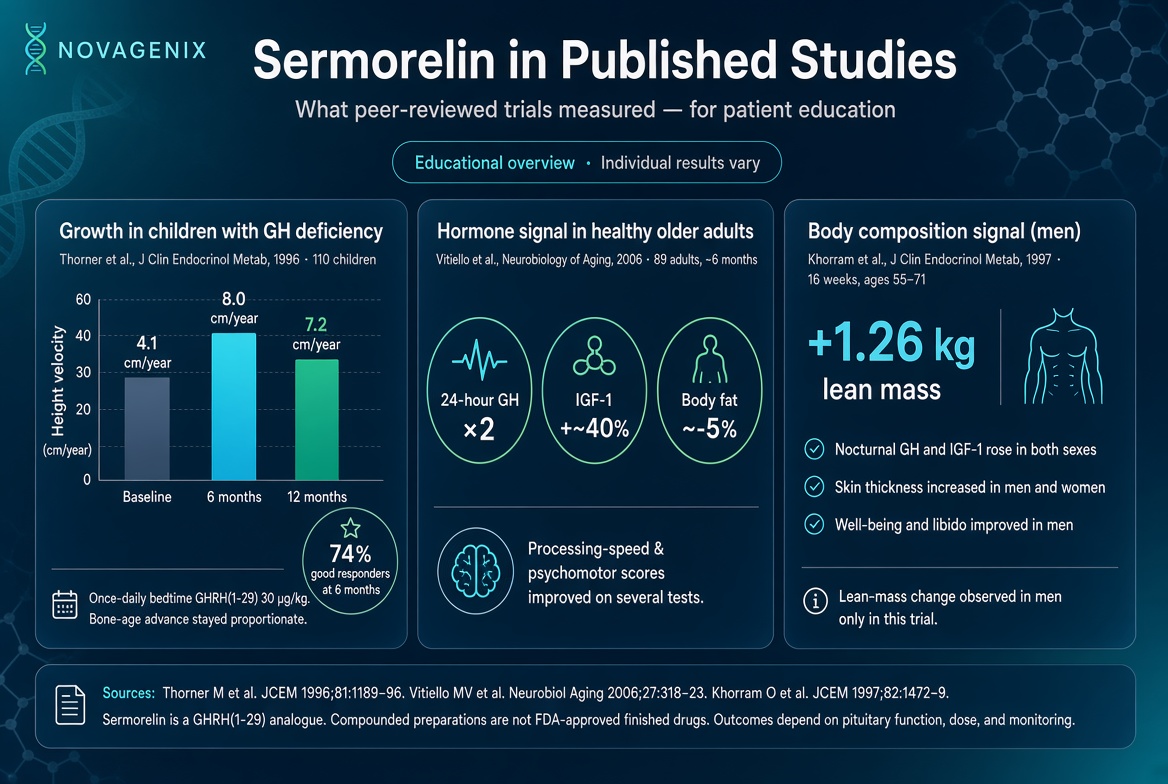
The only dose the FDA ever approved was weight-based, for children with growth failure, in a product discontinued in 2009. It does not translate to an adult.
Baseline IGF-1, the clinical picture, response on follow-up labs, and prescriber judgment. A number taken off a website and self-administered is not a treatment plan, and the pharmacy selling the vial is not the party monitoring your IGF-1.
Review symptoms, goals, medical history, medications, and prior treatment.
Complete a focused exam, records review, and labs when clinically appropriate.
Compare evidence, regulatory status, alternatives, uncertainty, cost, and risk.
If treatment is appropriate, monitor response, side effects, and ongoing need.
Sermorelin can affect a hormone pathway with effects throughout the body. Monitoring is more than a formality.
Call 911 for a medical emergency. Contact the prescribing clinician promptly for concerning or persistent symptoms.
From the GEREF prescribing information, the most common treatment-related adverse event was a local injection-site reaction: pain, swelling, or redness. Rotating injection sites was part of the labeled administration guidance. That is the effect you are most likely to actually encounter, and it is manageable.
One finding deserves more attention than it gets. The GEREF prescribing information reported that a large proportion of patients developed anti-GRF antibodies at some point during treatment. In the pediatric population studied, this did not appear to affect growth or produce a distinct adverse-reaction pattern. It is a documented immunological response to the drug, and it is rarely mentioned in consumer material about sermorelin.
Because sermorelin raises growth hormone and therefore IGF-1, the considerations that apply to any growth-hormone-raising therapy apply here, which is why IGF-1 and glucose belong in monitoring rather than being optional.
Sermorelin is a peptide, a short chain of amino acids. Peptides taken by mouth are broken down by digestive enzymes, which is why peptide medicines are generally injected rather than swallowed. The FDA-approved sermorelin product was an injection.
Nasal formulations attempt to bypass digestion, but absorption and dose consistency by that route have not been established for this drug to an approval standard.
If you are considering an oral or spray product, the question worth asking the seller is what evidence exists that it delivers the peptide intact.
Both are GHRH analogs and both raise the body's own growth hormone. The difference that matters is regulatory. Tesamorelin (Egrifta) holds a current FDA approval for reducing excess abdominal fat in adults with HIV-associated lipodystrophy, with an approved adult dose of 1.28 mg once daily for EGRIFTA WR. Sermorelin's approval was withdrawn in 2009, its only approved indication was pediatric, and it has never had an approved adult dose.
Tesamorelin has a current adult approval, a label, and studied dosing. Sermorelin does not. If the two are being presented as interchangeable peptides, that is the difference being glossed over.
The full side-by-side comparison, including dosing, safety, and whether they can be combined, is on its own page: tesamorelin vs. sermorelin.
A related question comes up just as often: whether a GHRH analog like this is interchangeable with injected growth hormone. It is not, and the mechanisms differ in ways that matter for monitoring — see tesamorelin vs. HGH.
Different receptors. Sermorelin is a GHRH analog acting on the GHRH receptor. Ipamorelin is a growth-hormone secretagogue acting on the ghrelin receptor. Neither holds a current FDA approval for adult use, and both are compounded when prescribed. Claims that one is definitively superior for adult outcomes outrun the published evidence for both.
The full comparison with ipamorelin, covering the receptor difference, the selectivity claim, and whether they are combined, is here: sermorelin vs. ipamorelin.
Sermorelin has no FDA-approved weight-loss indication. Its approved indication was pediatric growth failure, not body composition in adults.
Semaglutide and tirzepatide do hold FDA-approved indications for weight management. That is a difference in regulatory status, not a judgment about any individual patient, but if weight loss is the goal it is the difference worth understanding before spending money.
If that is what brought you here, the more relevant starting points are our medically supervised weight loss programs, semaglutide, and tirzepatide.
FDA-approved for one specific indication
Explore this page →Compare approved, compounded, and investigational categories
Explore this page →NovaGenix serves patients at 609 N. Hepburn Ave., Suite 106, Jupiter, Florida, with telemedicine available to eligible patients throughout Florida.
Cost and availability depend on the medically appropriate option, pharmacy or product, monitoring, and insurance status. The team explains expected costs before treatment begins.
Current sermorelin preparations used in practice are not FDA-approved finished drug products. If compounded, the preparation is made for an individual patient by a licensed pharmacy and is not equivalent to FDA approval.
No. Sermorelin is a GHRH analogue that signals the pituitary gland; injectable growth hormone supplies growth hormone directly.
Those outcomes should not be promised. Any change varies by patient, and broad anti-aging, fat-loss, or muscle-building claims are not established indications.
The physician may review IGF-1, glucose-related markers, thyroid or other endocrine data, and additional labs based on history and symptoms.
Eligible Florida patients may begin with telemedicine when clinically appropriate. Some evaluations or follow-up needs may require in-person care or local laboratory testing.
Discuss your goals, medical history, evidence-based options, and whether this therapy—or a different approach—may be appropriate.
Learn what you want to know about hormone therapy by scheduling a free consultation.
Contact Us Today
609 N Hepburn Ave Ste 106, Jupiter, FL 33458

Monday - Friday: 9:00 am - 5:00 pm | Saturday-Sunday: Closed

