WHAT IT IS
A synthetic peptide that activates the ghrelin receptor and can stimulate pituitary growth hormone release.

Connect with us


.png)

Schedule a Consultation!
A clear, physician-led review of an investigational growth hormone secretagogue, its changing compounding status, limited human evidence, and safer clinical decision-making.
Timothy Mackey, D.O., Medical Director
Florida License OS9185 · Updated September 2026
A consultation does not guarantee a prescription. Eligible Florida patients may be seen by telemedicine when clinically appropriate.

A synthetic peptide that activates the ghrelin receptor and can stimulate pituitary growth hormone release.
Ipamorelin is not FDA-approved for any indication. Its compounding status and availability have changed over time.
Human evidence is limited, and popular claims about fat loss, muscle, recovery, and anti-aging are not established indications.
Ipamorelin is commonly described online as a selective growth hormone secretagogue. Mechanism alone, however, does not establish that a medication is safe, effective, or appropriate for a specific wellness goal.
FDA has identified concerns involving aggregation, peptide-related impurities, immunogenicity, and product characterization for compounded ipamorelin. Current availability must be confirmed rather than assumed.
Read the peptide therapy cornerstone guide →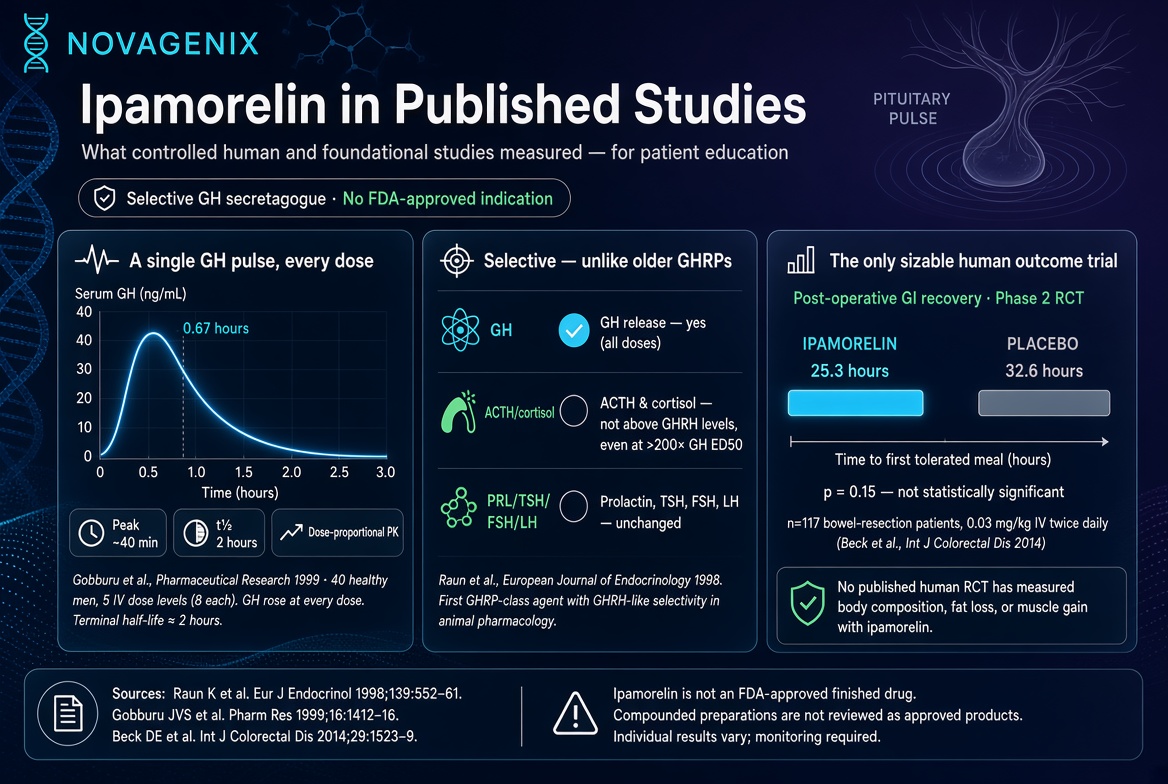
Review symptoms, goals, medical history, medications, and prior treatment.
Complete a focused exam, records review, and labs when clinically appropriate.
Compare evidence, regulatory status, alternatives, uncertainty, cost, and risk.
If treatment is appropriate, monitor response, side effects, and ongoing need.
The most important first question is not “What dose?” It is whether the substance is legally available, adequately characterized, and medically justified.
Call 911 for a medical emergency. Contact the prescribing clinician promptly for concerning or persistent symptoms.
They are the two peptides most often discussed together, and most comparisons online treat them as two versions of the same idea. They are not. Sermorelin acts on the GHRH receptor in the pituitary; ipamorelin acts on the ghrelin receptor. Both are compounded rather than dispensed against a current FDA approval for adult use, and both are named in the same subsection of the WADA Prohibited List.
We cover the receptor difference, the selectivity claim and what the evidence does and does not support in detail on a separate page: Sermorelin vs. ipamorelin.
This is the sharper of the two comparisons, because the regulatory positions are not equivalent. Tesamorelin holds a current FDA approval, with a labeled adult dose, for reducing excess visceral abdominal fat in adults with HIV-associated lipodystrophy. Ipamorelin has never held an approval for any indication, in any population.
They also act through different receptors — tesamorelin on the GHRH receptor, ipamorelin on the ghrelin receptor — which is why the question of combining them comes up so often, and why the answer is more complicated than “two pathways, so it adds up.” The full comparison, including what the FDA has said about combination products: tesamorelin vs. ipamorelin.
A different GHRH-based pathway
Explore this page →Understand regulatory categories before deciding
Explore this page →NovaGenix serves patients at 609 N. Hepburn Ave., Suite 106, Jupiter, Florida, with telemedicine available to eligible patients throughout Florida.
Cost and availability depend on the medically appropriate option, pharmacy or product, monitoring, and insurance status. The team explains expected costs before treatment begins.
No. Ipamorelin is not FDA-approved for any medical indication.
The federal compounding position has changed and may continue to change. Availability depends on current law, FDA policy, and what a licensed pharmacy is permitted to prepare.
No. Those are common promotional claims, but robust human evidence establishing those outcomes and long-term safety is lacking.
Patients encounter ipamorelin online. Clear education helps distinguish mechanism, evidence, regulatory status, and safer alternatives.
The physician reviews the underlying concern, history, medications, laboratories when appropriate, and evidence-based options. A consultation does not guarantee a prescription.
Discuss your goals, medical history, evidence-based options, and whether this therapy—or a different approach—may be appropriate.
Learn what you want to know about hormone therapy by scheduling a free consultation.
Contact Us Today
609 N Hepburn Ave Ste 106, Jupiter, FL 33458

Monday - Friday: 9:00 am - 5:00 pm | Saturday-Sunday: Closed

